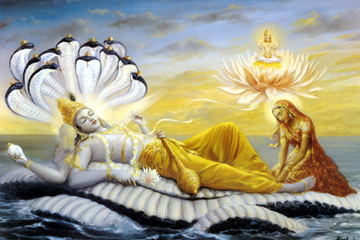
Sayan Ekadashi Deva Sayani Ekadashi Padma Ekadashi from the Bhavishya-uttara Purana.
The saintly king Yudhishthira Maharaj said, “Oh Keshava, what is the name of that Ekadashi that occurs during the light fortnight of the month of Ashadha (June July)? Who is the worshippable Deity for the auspicious day, and what is the process for observing this event?”
Lord Sri Krishna replied, “Oh caretaker of this Earthly planet, I shall gladly tell you a wonderful historical event that the deva lord Brahma once narrated to his son Narad Muni.
The appearance anniversary of Srila Vyasadeva, the compiler of the Vedic literature.
This event really is directed towards Srila Vyasadeva, thus in some sampradayas they refer to Guru Purnima as Vyasa Purnima. Traditionally it is the day when the guru is worshipped.
In the book Festivals, Fairs and Fasts of India (Shakti M Gupta. 1991. Clarion books. page 88-89.) It says: Guru Purnima "……is observed on the full moon day in the month of Ashadha in honour of the sage Vyasa, by keeping a fast, worshippig him for His blessings and to gain wisdom. Formerly on this day, gurus who were the traditional teachers, were honoured by their pupils.
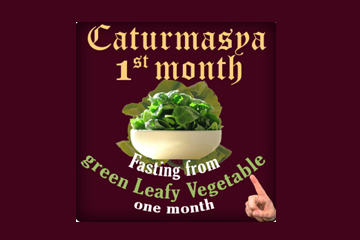
First month: No leafy vegetables, such as spinach, salads of all types, cabbages of all types, kale, leafy herbs like coriander, mint, parsley, curry and powdered leafy herbs and teas.
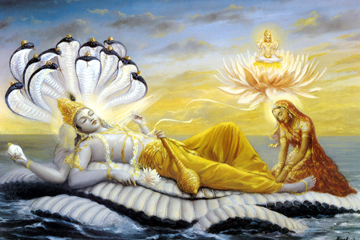
Caturmasya stands for ‘four months’. It is the period between sayana and uttana ekadasis. The scriptures refer to this period as the duration of Lord Visnu’s sleep in this universe.
The main goal of observing Caturmasya is to decrease attachment to material things and to increase devotion to Krishna.
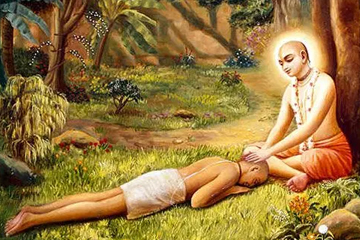
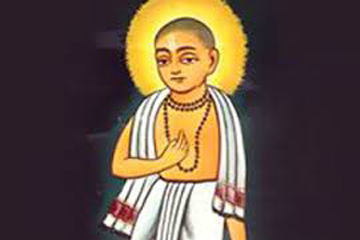
Sri Gopala Bhatta Goswami appeared in Sri Rangam, South India. Lord Caitanya once stayed four months in his home, & converted the family to Gaudiya Vaisnavism. A mere boy at this time, Gopala personally served the Lord.
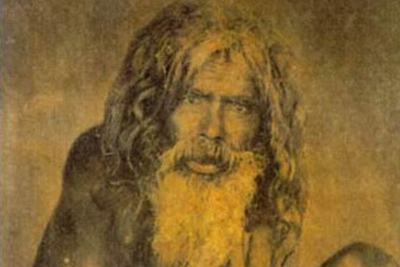
Lokanatha Goswami was a personal associate of Lord Caitanya. Lord Caitanya ordered him and Bhugarbha Goswami to find the lost holy places of Vrndavana. Years later, the six Goswamis came to Vrndavana and continued this work.
The saintly king Yudhisthira maharaj said, “Oh Supreme Lord, I have heard from You the glories of fasting on Deva-sayani Ekadashi, which occurs during the light fortnight of the month of Ashadha. Now I would like to hear from You the glories of the Ekadashi that occurs during the dark fortnight (krishna paksha) of the month of Shravana (July – August). Oh Govindadeva, please be merciful to me and explain its glories. Oh Supreme Vasudeva, I offer my most humble obeisances unto You.”
Shri Yudhisthira Maharaja said, “Oh Madhusudana, Oh killer of the Madhu demon, please be merciful to me and describe to me the Ekadashi that occurs during the light fortnight of the month of Shravana (July-August).” The Supreme Lord, Sri Krishna, replied, “Yes, Oh king, I shall happily narrate its glories to you, for just by hearing about this sacred Ekadashi one attains the merit of performing a horse sacrifice.
“At the dawn of Dvarpara-yuga there lived a king by the name of Mahijita, who ruled the kingdom of Mahismati-puri. Because he had no son, his entire kingdom seemed utterly cheerless to him. A married man who has no son gains no happiness in this life or the next.
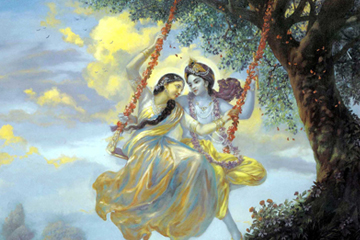
The swing festival of Radha-Krsna. The Deities ride on an elaborately decorated swing.
Deities in the temples are swung on a swing. Some of the main temples that this festival is celebrated at are the Banke Bihari Temple and the Radha-Raman Temple in Vrindavana, the Dwarkadish temple in Mathura, and the Larily Lal Temple in Varsana.
In our Iskcon temples we observe for five days in accordance with Srila Prabhupada's instructions. So whether one observes for the four days or for the seven, or thirteen days, the same festival is put on for the pleasure of the Lord and His loving associates.
This is a wonderful ceremonial function of Lord Krishna's pastimes that reflects practically how we are to render service to the Lord for His pleasure.
Registration for Sloka Classes. New Module. Bhagavad Gita Chapter -9
Sarva Seva Sankalp
Krishna Balaram Sevak
Youth Hostels
Life Patronship
GYAN DAAN SEVA
Sadhu Bhoj
MANDIR NIRMANA SEVA
ANNADANA SEVA
Congratulations you have taken one giant step towards giving a sanctified healthy meal to an underprivileged Indian.
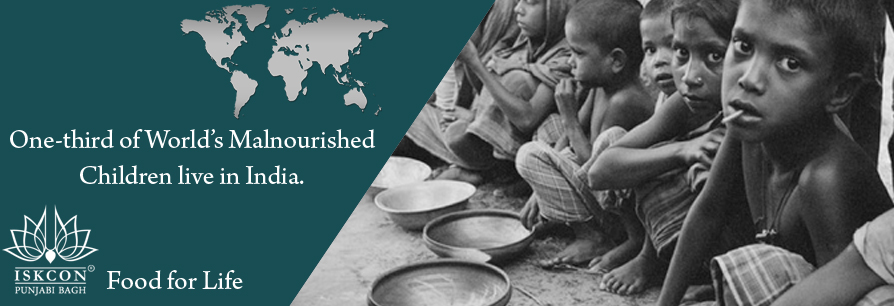
Face the fact: (Source Global Huger Index 2017)
India is world’s second largest food producer yet it is home to world second biggest undernourished population. Source FAO 2015 25 % of all hungry people worldwide live in India. 44% of Indian Children below the age of 5 are underweight. Out of Worst hunger struck 119 countries India is at 100
What does a healthy human being need?
A balanced diet is one that helps a person maintain or improve health. It includes carbohydrates, fats, vitamins, proteins, roughage, water, and minerals. The amount of these nutrients varies with gender, age, occupation, climate and region. However, at ISKCON Punjabi Bagh, we understand that a complete meal is not just numbers and formulae. It is not just chopped-up vegetables and boiled grains. It is love that is the primary constituent of a healthy meal. The same love that a mother pours while she is at work in the kitchen, the same love that a father ploughs when he is toiling in the office, and the same love that siblings share when they fight.
How does ISKCON Punjabi Bagh satisfy this hunger?
We, at ISKCON Punjabi Bagh, understand that apart from a person’s body craving for satisfaction of the stomach, the satisfaction of the person occupying that body is also of primary importance. We solve this eternal craving of the soul through World’s Largest vegetarian Non-Profit Food Relief program called the Hare Krishna Food-for-Life.
Each meal is not only delicious but is also prepared with full attention to personnel & infrastructure hygiene. The food so prepared is first offered to the almighty Supreme Personality of Godhead Sri Krishna, therefore, although its quantity remains unchanged but qualitatively it is transformed from meal to Prasadam. Such sanctified meals on the one hand fulfil the basic necessity of the body and on the other purify the consciousness of a person. The fortunate people who receive Prasadam meals develop all good human qualities such as kindness, truthfulness, cleanliness, and gain immense control over the agitations of mind. No other food item in the world can offer such spiritual benefits.
Is it really World’s Largest?
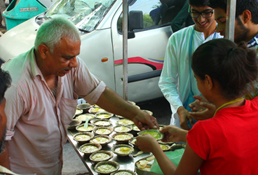
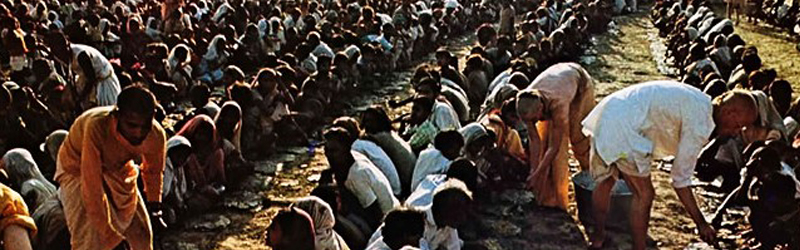
Yes, ISKCON volunteers provide up to 2,000,000 (Two Million) free meals every day. His Divine Grace A.C. Bhaktivedanta Swami Srila Prabhupada, the Founder-Acharya of ISKCON, instructed his disciples that no one should sleep hungry within a 10 mile radius of a Hare Krishna centre. Keeping true to His Divine Grace’s instructions, every centre based on the available resources tries to serve nutritious meals free of cost to every person who gives the temple an opportunity to serve. This includes visitors, pilgrims, and residents of neighbouring areas. In fact, monthly processions are also accompanied by free distribution of food. Apart from this, special relief packages are designed and dispatched to areas affected by natural calamities.
Can non-ISKCON people contribute?
We are all children of the Supreme Personality of Godhead. This makes us God-brothers & God-sisters. Therefore, we encourage the more fortunate brothers and sisters to come forward and help the less fortunate ones. This can be achieved by sponsoring meals for the homeless, disadvantaged children, pilgrims and slum dwellers. We have created this web-page specifically for reaching out to people who have a big heart and a little time, energy and resources to spare. Your small contribution here can make 2 square meals possible for unprivileged brethren.
Where will my money go?
As every ISKCON temple is completely financially independent of the other, all money donated to ISKCON Punjabi Bagh temple is utilized locally within New Delhi. At times, we also travel the Indian sub-continent and distribute free Prasadam across the length and breadth of India.
No money from your donation is transferred outside the country without explicitly mentioning it. ISKCON centres worldwide manage their funds locally for the benefit of that region’s local population.
Because of this reason,currently, ISKCON Punjabi Bagh also does not accept any donations from foreign countries for the Food for Life program. In case, you are eager to contribute we suggest getting in touch with an ISKCON centre in your neighbouring area. The complete list of ISKCON centres world wide can be found here: http://centers.iskcondesiretree.com/ Hopefully, at a later time, when people all over the world have transcended the boundaries of nationality, colour, language, ethnicity and politics, we might be able to extend ourselves to help all children of God irrespective of geographical location.
I am still not sure if I want to contribute!
No Problem, we thank you for taking out time to read about the Hare Krishna Food for Life program. we suggest that you scroll through the rest of the website. It is highly probable that you will find another social cause that is worth investing your time and resources in such as education, organic farming, sustainable living and much more.