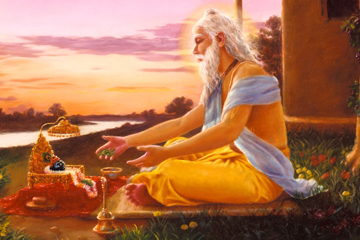
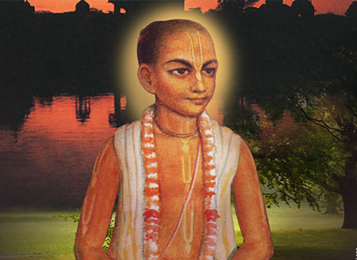
Advaita Acharya, an intimate associate of Sri Caitanya Mahaprabhu, is considered an incarnation of Sadasiva and Maha- Visnu. It was in response to His calls that Sri Caitanya Mahaprabhu descended to this world.
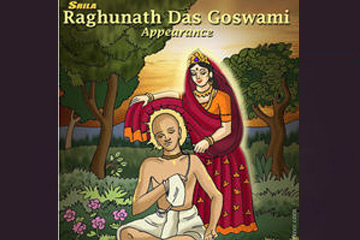
Raghunatha Dasa Goswami, one of the six Goswamis, at a young age renounced his beautiful wife and opulent home to join Lord Caitanya and His sankirtana movement. For sixteen years, he was the personal assistant of Svarupa Damodara.
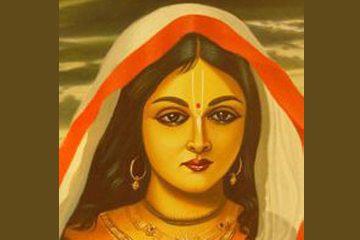
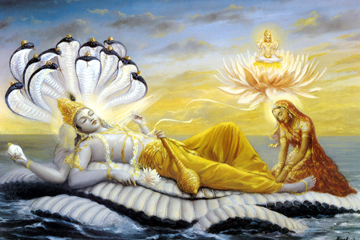
The Supreme Lord Visnu has three different Saktis: Sri, Bhu, and Nila. Sri Visnupriya is the internal potency known as Bhu-sakti. She appeared in Gaura-lila to assist Sri Caitanya Mahaprabhu with his mission of spreading the holy name of Krsna.
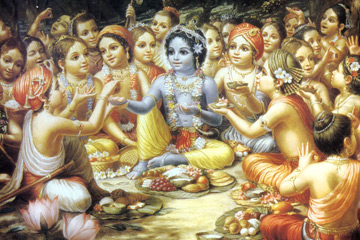
This is the first day of spring in India. On the fifth day of the waxing moon one should celebrate the coming of spring to Vrindavana by offering Krishna many types of leaves and flowers, and fresh shoots of sprouting grasses.
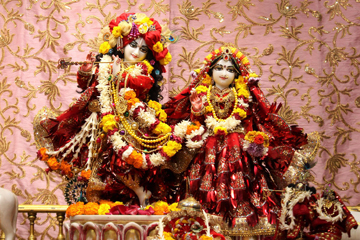
Things that symbolise life and new growth.Following in the footsteps of the Vraja-basis of Vrindavana, one should paint designs on His (Krishna’s) body and perform a special aratrika for Him. It is appropriate to offer yellow flowers too. The vasanta raga should be played on this day. The Deities in the temples, especially in Vrindavana wear yellow or yellow and green on this day.
In places like Vrindavan, Mayapur, Jagannath Puri and Udupi many of the women folk dress in yellow also. As it is the first day of spring many fertility rites are performed at this time – for the family, for the women folk, for the crops, for the cows, etc. It’s a very festive time.
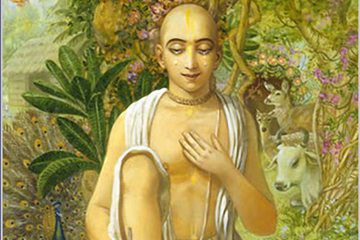
Pundarika Vidyanidhi was a disciple of Madhavendra Puri and was the guru of Sri Gadadhara Pandita. Pundarika Vidyanidhi was sometimes misunderstood to be too much attached to material pleasures, but just by hearing the recitation of one verse of the Bhagavatam he would enter into a trance.
Visvanatha Cakravarti Thakura, a great Vaisnava acarya, appeared in 1674 in what is now the Nadia district of West Bengal. During his time, he served as the protector, guardian, and acarya of the Gaudiya Vaisnava line.
Raghunandan was born into a family of physicians in the Shaka year 1432 (1510 AD). His father’s name was Mukunda Das, his mother’s name is unknown. Mukunda Das was Narahari Sarkar Thakur’s older brother.
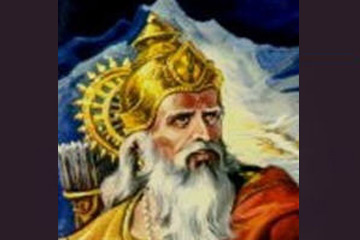
King Mahabhisheka after his death, attained Vishnuloka. Once he went to visit Brahma at Satyaloka. At that time Ganga devi was also present in Brahma's assembly. In that pious atmosphere, a gentle breeze began to blow and Gangadevi's clothes were slightly deranged. Just at that moment Mahabhisheka took a stealthy glance at her and she also returned that glance. This was noted by Brahma who turned both of them into human beings by a curse. Gangadevi begged pardon and Brahma lifted the curse and blessed her that the Ashthavasus would come to the earth to be born as her sons and that afterwards she could come back to heaven. After that Gangadevi was born as a mortal woman in the world under the name Ganga and she spent her days in the forests near the Ganga river valleys.
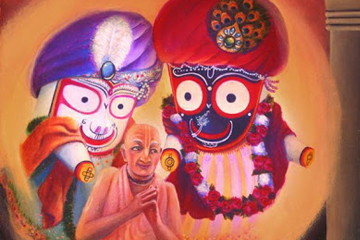
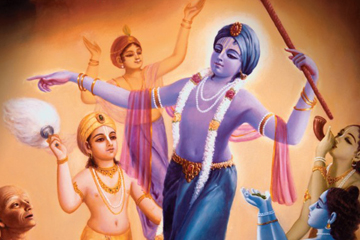
Lord Nityananda Prabhu appeared as Lord Caitanya’s principal associate for spreading the congregational chanting of the holy names of the Lord. He especially spread the holy name of the Lord throughout Bengal. He is considered an incarnation of Lord Balarama.
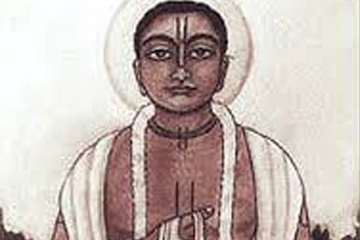
Narottama Dasa Thakura was a leading acarya in the Gaudiya Vaisnava line. He was the only disciple of Srila Lokanatha Gosvami. Srila Narottama Dasa Thakura helped bring the books of the Gosvamis from Vrndavana to Bengal and Orissa.
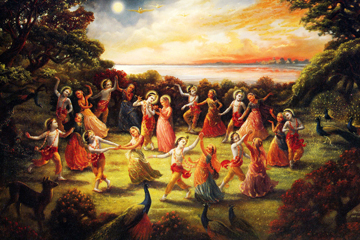
There are various festivities where Lord Krishna’s rasa lila is celebrated – this festival being just one of them. The purnima or full moon of Damodara month is the second full moon of the autumn season, and rasa lila is again celebrated.
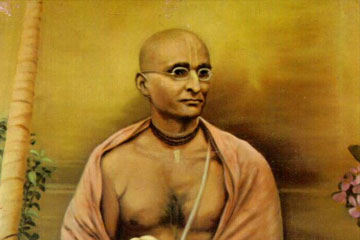
Bhaktisiddhanta Sarasvati Thakura was the spiritual master of Srila Prabhupada. Srila Bhaktisiddhanta Sarasvati Thakura powerfully spread the teachings of Lord Caitanya Mahaprabhu in the early twentieth century.
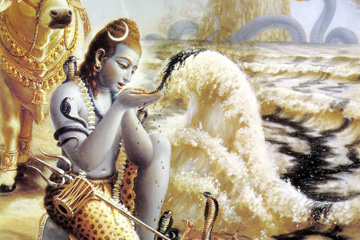
Siva Ratri worship of Lord Siva. Devotees may bathe a Siva-linga in water and panca-gavya (five substances from the cow) and offer Krsna-prasada to Lord Siva. Fasting is optional for Vaisnavas.
Every lunar month on the 13th or 14th day of the dark half of the moon phase there is a Shivaratri but in the Vedic month of Phalgun (February-March) there is a Maha Shivaratri. The ceremony takes place mainly at night, which is observed in the honour of Lord Shiva, who was married to Parvati (Mother Durga) on this day.
Devotees of Lord Shiva generally observe a strict fast on this day and some go to the extent of a nirjal fast i.e. they do not even have a sip of water.
Yudhisthira Maharaj said, “Oh Lord Sri Krishna, O glorious son of Vasudeva, please be merciful to me and describe the Ekadasii that occurs during the dark fortnight of the month of Phalguna (February-March)”
Lord Sri Krishna replied, “Oh Yudhisthira, Oh king of kings, gladly I shall tell you about this great fast, known as Vijaya Ekadasii. Whoever observes it certainly achieves success in this life and the next. All the sins of one who fasts on this Ekadasii and hears its sublime glories are eradicated.
“Narada Muni once asked lord Brahma, who sits on a lotus flower about the Vijaya Ekadasii. Sri Narada said, ‘Oh best of all the demigods, kindly tell me the merit one can achieve by faithfully observing Vijaya Ekadasii.’
Isvara Puri was the spiritual master of Sri Caitanya Mahaprabhu. Even though Lord Caitanya, the Supreme Godhead, did not need a spiritual master, He accepted Srila Isvara Puri as His guru to establish the importance of accepting a spiritual master.
Rasikananda Prabhu preached Krsna consciousness in northern Orissa after the disappearance of Lord Caitanya. He was the principal disciple of Syamananda Gosvami.
Accepting the order of his guru, Sri Syamananda, on his head, Rasikananda preached the message of Sri Gaursundar in the world for approximately 16 years. Thereafter he entered into his eternal pastimes through the lotus feet of Gopinatha at Remuna. On the first day of the bright fortnight in the month of Phalguna, Sakabda 1574 (1652AD), Rasikananda quietly slipped out of the village Santa without anyone's notice and walked to Remuna. Arriving there, he discussed Krsna-katha with the devotees there for a while and instructed everyone to serve Sri Krsna with devotion.
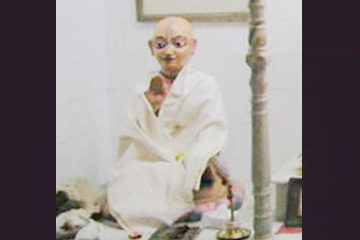
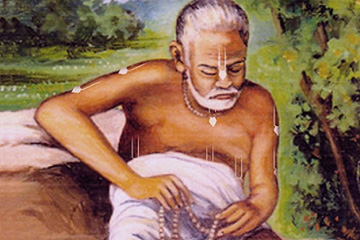
Srila Jagannatha Dasa Babaji Maharaja lived for 140 years. He took diksa from Sri Madhusudana Dasa Babaji and did bhajana for many year at Surya Kunda in vrindavana.
Registration for Sloka Classes. New Module. Bhagavad Gita Chapter -9
Sarva Seva Sankalp
Krishna Balaram Sevak
Youth Hostels
Life Patronship
GYAN DAAN SEVA
Sadhu Bhoj
MANDIR NIRMANA SEVA
ANNADANA SEVA
Congratulations you have taken one giant step towards giving a sanctified healthy meal to an underprivileged Indian.
Face the fact: (Source Global Huger Index 2017)
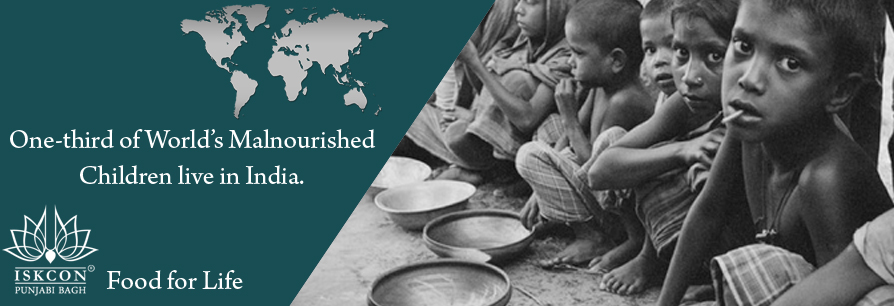
India is world’s second largest food producer yet it is home to world second biggest undernourished population. Source FAO 2015 25 % of all hungry people worldwide live in India. 44% of Indian Children below the age of 5 are underweight. Out of Worst hunger struck 119 countries India is at 100
What does a healthy human being need?
A balanced diet is one that helps a person maintain or improve health. It includes carbohydrates, fats, vitamins, proteins, roughage, water, and minerals. The amount of these nutrients varies with gender, age, occupation, climate and region. However, at ISKCON Punjabi Bagh, we understand that a complete meal is not just numbers and formulae. It is not just chopped-up vegetables and boiled grains. It is love that is the primary constituent of a healthy meal. The same love that a mother pours while she is at work in the kitchen, the same love that a father ploughs when he is toiling in the office, and the same love that siblings share when they fight.
How does ISKCON Punjabi Bagh satisfy this hunger?
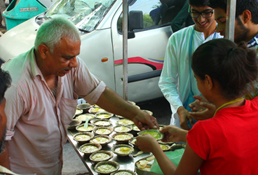
We, at ISKCON Punjabi Bagh, understand that apart from a person’s body craving for satisfaction of the stomach, the satisfaction of the person occupying that body is also of primary importance. We solve this eternal craving of the soul through World’s Largest vegetarian Non-Profit Food Relief program called the Hare Krishna Food-for-Life.
Each meal is not only delicious but is also prepared with full attention to personnel & infrastructure hygiene. The food so prepared is first offered to the almighty Supreme Personality of Godhead Sri Krishna, therefore, although its quantity remains unchanged but qualitatively it is transformed from meal to Prasadam. Such sanctified meals on the one hand fulfil the basic necessity of the body and on the other purify the consciousness of a person. The fortunate people who receive Prasadam meals develop all good human qualities such as kindness, truthfulness, cleanliness, and gain immense control over the agitations of mind. No other food item in the world can offer such spiritual benefits.
Is it really World’s Largest?
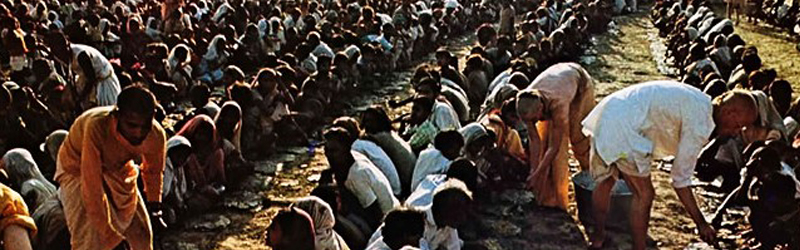
Yes, ISKCON volunteers provide up to 2,000,000 (Two Million) free meals every day. His Divine Grace A.C. Bhaktivedanta Swami Srila Prabhupada, the Founder-Acharya of ISKCON, instructed his disciples that no one should sleep hungry within a 10 mile radius of a Hare Krishna centre. Keeping true to His Divine Grace’s instructions, every centre based on the available resources tries to serve nutritious meals free of cost to every person who gives the temple an opportunity to serve. This includes visitors, pilgrims, and residents of neighbouring areas. In fact, monthly processions are also accompanied by free distribution of food. Apart from this, special relief packages are designed and dispatched to areas affected by natural calamities.
Can non-ISKCON people contribute?
We are all children of the Supreme Personality of Godhead. This makes us God-brothers & God-sisters. Therefore, we encourage the more fortunate brothers and sisters to come forward and help the less fortunate ones. This can be achieved by sponsoring meals for the homeless, disadvantaged children, pilgrims and slum dwellers. We have created this web-page specifically for reaching out to people who have a big heart and a little time, energy and resources to spare. Your small contribution here can make 2 square meals possible for unprivileged brethren.
Where will my money go?
As every ISKCON temple is completely financially independent of the other, all money donated to ISKCON Punjabi Bagh temple is utilized locally within New Delhi. At times, we also travel the Indian sub-continent and distribute free Prasadam across the length and breadth of India.
No money from your donation is transferred outside the country without explicitly mentioning it. ISKCON centres worldwide manage their funds locally for the benefit of that region’s local population.
Because of this reason,currently, ISKCON Punjabi Bagh also does not accept any donations from foreign countries for the Food for Life program. In case, you are eager to contribute we suggest getting in touch with an ISKCON centre in your neighbouring area. The complete list of ISKCON centres world wide can be found here: http://centers.iskcondesiretree.com/ Hopefully, at a later time, when people all over the world have transcended the boundaries of nationality, colour, language, ethnicity and politics, we might be able to extend ourselves to help all children of God irrespective of geographical location.
I am still not sure if I want to contribute!
No Problem, we thank you for taking out time to read about the Hare Krishna Food for Life program. we suggest that you scroll through the rest of the website. It is highly probable that you will find another social cause that is worth investing your time and resources in such as education, organic farming, sustainable living and much more.